The Fastest Route To Citations
🚀 Create data only your business can publish, and more!

Hello! You've arrived at What Actually Works 🤓
We break down the real strategies, decisions, and plays that actually move the needle in your marketing, and here it for today.
🚀The Fastest Route To Citations
When multiple sources say roughly the same thing, AI systems pick the most authoritative. But when one brand owns a data point nobody else can replicate, AI systems cite that brand every time that data point becomes relevant.
There's no alternative source to pull from.
When you own a unique metric, you create a source of truth that AI models can't synthesize or ignore. If they can't replicate your data, they are forced to cite your name. Here's how to manufacture that data from what you already have.
Mine your existing operations first
Every business sitting on operational data is sitting on citation assets it hasn't named yet.
A DTC brand processing thousands of orders has return rate data by product category no industry report covers at that specificity. An agency running campaigns across dozens of accounts has performance benchmarks for their category mix that no public dataset replicates. A SaaS company with thousands of users has usage pattern data no analyst firm can access.
None of this requires original research. It requires naming what you already know.
Pull three to five operational metrics your business tracks internally that no competitor could replicate. Give each one a name. Publish them with a one-sentence methodology note. That naming and documentation transforms internal data into a citable proprietary source.
Structure proprietary data for extraction
A proprietary metric buried in paragraph seven doesn't get cited. A named statistic positioned as a standalone passage does.
Structure every proprietary data point using this format: metric name in bold, finding as a standalone sentence, methodology in one sentence, date of measurement. Under 75 words total. Claim, evidence, attribution, recency, one self-contained extractable unit.
Publish these blocks as dedicated sections on relevant pages, not embedded in narrative prose.
Publish on a quarterly cadence
A single data point gets cited until something fresher displaces it. A brand publishing new proprietary data quarterly becomes a recurring citation source AI systems return to consistently.
Each quarter: three to five new operational metrics, named, structured, published to citation-target pages.
Track whether data publications are entering the citation pool. SEMrush's AI Visibility Toolkit monitors citation movement across ChatGPT and Google AI Mode so you can confirm the data is being picked up. You can try it free for 7 days.
AI cites what it can't replicate. Give it something nobody else has.
Partnership with Stack Influence
Stop renting Amazon visibility. Start building a rank you keep.

Every dollar of PPC buys you a moment of visibility. Stop bidding, and your rank slides right back. You are renting, not building.
Here is the alternative play: when real shoppers discover your product outside Amazon and buy it, the algorithm reads that external traffic as genuine demand and rewards it with an organic rank that sticks after the campaign ends.
Stack Influence makes that engine repeatable. Send free product to vetted micro-influencers; they buy on Amazon, post authentic content to their own audiences, and drive the outside traffic that moves your listing. No cash fees, no manual outreach.
The results: one product activated 187 influencers and saw BSR improve 11X and recurring sales 8X, worth $342K YoY. Another went from zero to $150K a year and an Amazon's Choice badge on 291 creators. It is the same model behind growth at Magic Spoon, Unilever, and Thrasio.
If you are scaling on Amazon, this belongs in your stack.
Sign up this week and save 10% on your first campaign.
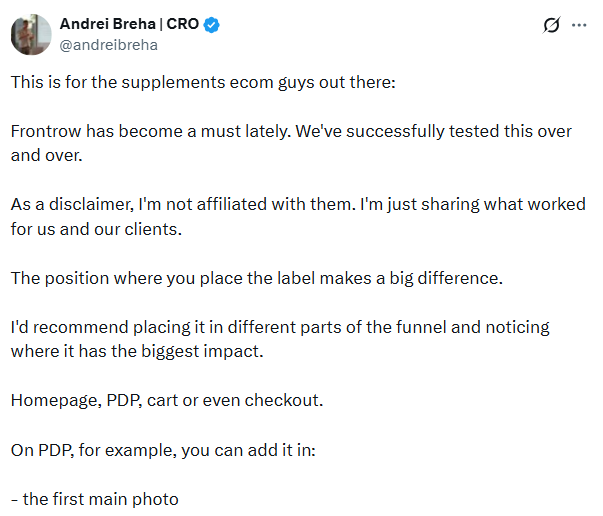
🐥 Tweet Worth Saving
Thanks for being part of the WAW team 💃 We’d love to know if this was helpful so we can continue playing it smart with the right strategies.