Optimism is killing trust
👀 The thing that loses client trust fastest isn't a bad week. It's what you say on the Monday call after one.

Hello! You've arrived at What Actually Works 🤓
We break down the real strategies, decisions, and plays that actually move the needle in your marketing, and here it for today.
The thing that loses client trust fastest isn't a bad week. It's what you say on the Monday call after one.
Every account person knows this. When performance drops, the client needs three things: what happened, why it happened, and what changes when.
Diagnosis and timeline. Not reassurance. Every account person knows this, and almost every account person defaults to reassurance anyway the moment the call starts.
The reason is worth being honest about. The optimism reflex is not client-protective. It is self-protective. "Don't worry, it'll bounce back" exists to get the account person through the next four minutes of discomfort, not to give the client anything useful.
Once you name it that way, it becomes considerably harder to perform. It is difficult to say something you have just recognized as self-serving while someone is paying you to be straight with them.
The script exists. Most people just haven't written it before they need it.
The reflex happens under pressure because the account person reaches for whatever script is available, and the available one is reassurance. The antidote is a bad-news script built before the bad week arrives, not during it.
Four parts. No exceptions.
- What happened: specific numbers, no softening, no passive voice
- Why it happened: the actual diagnosis, not a hypothesis dressed as certainty
- What's being done: specific actions with named owners, not "we're looking into it."
- When the client will see it change: a date, not a range, not "soon."
Write a version of this for every common failure mode the account is likely to face: creative fatigue, audience saturation, attribution breaks, seasonal compression. The script sitting in a doc before the bad week arrives is the difference between a Monday call that builds trust and one that quietly begins eroding it.
The fix that makes Monday easier is a Friday ritual.
The optimism reflex is most powerful when the account person is processing bad news for the first time in front of the client. The structural solution is processing it Friday internally instead.
Every Friday, the team reviews the week's performance, names the problems honestly with each other, and drafts the Monday update before leaving. By the time Monday arrives, the diagnosis is owned, the actions are assigned, the timeline is committed, and the script is written. The client receives certainty delivered calmly rather than reassurance delivered nervously.
Anyone can handle a good week. The client is paying for whoever can handle a bad one without flinching.
Partnership with AirOps
Google didn't update Search at I/O 2026. It replaced it.

AI Mode is expanding. The Search box just got its biggest AI upgrade in decades. Search agents now crawl the web and answer for users in the background, before anyone reaches your page.
If you're still grading yourself on rankings and traffic, you're scoring a game that no longer exists.
On June 17th, Chris Long, co-founder of Nectiv, breaks down what changed, what it means for B2B visibility, and how to build the workflows that get you cited in AI search.
In 60 minutes, you'll get:
- The I/O 2026 updates that belong on your roadmap now
- How to measure visibility past rankings: citations, prompt coverage, mentions
- What makes content surface in fan-out and decision-stage queries
- The workflows to audit, refresh, and publish content built for AI search
The old rules are gone. This session covers what replaced them.
Secure your free spot (Button)
Can't make it live? Register anyway and get the recording in your inbox within 24 hours.
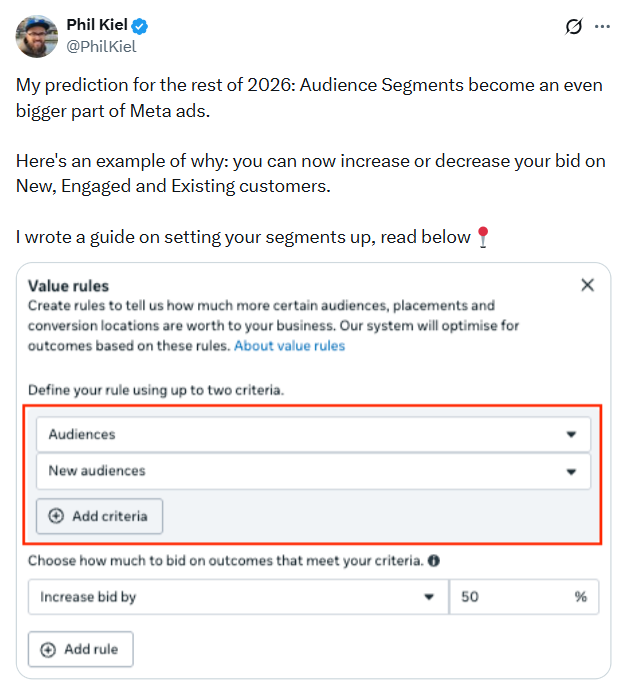
🐥 Tweet Worth Saving
Thanks for being part of the WAW team 💃 We’d love to know if this was helpful so we can continue playing it smart with the right strategies.