Customers stay away because of this
🧐Two different reasons a customer doesn’t come back, and only one of them responds to a nudge, and more!

Hello! You've arrived at What Actually Works 🤓
We break down the real strategies, decisions, and plays that actually move the needle in your marketing, and here it for today.
🧐 Customers stay away because of this
When repeat purchase rates flatten, the usual response is to send another reminder. Another email. Another discount. Another “we miss you” campaign.
That approach assumes every customer who doesn’t come back is solving the same problem, when in reality two customers can disappear for completely different reasons even though the revenue report groups them together.
The difference becomes obvious once you stop measuring repeat purchase as one event and start measuring it one transition at a time.
The first missed purchase isn’t the same as the second
A customer who never places a second order is often fighting a memory problem.
The purchase hasn’t become part of their routine yet, so a well-timed reminder or a small incentive is frequently enough to bring them back.
A customer who buys twice and then disappears has already demonstrated they remember the brand.
The question changes.
Instead of “Should I buy again?” they’re often asking “Am I the kind of customer who keeps buying from this brand?”

That’s why the same email can perform well at one stage and fail completely at the next.
Diagnose the barrier before building the flow
The simplest way to separate these problems is by comparing engagement with conversion at each transition.
If both engagement and conversion are low, people aren’t even paying attention. That’s usually a reminder problem.
If engagement stays high while conversion remains weak, the emails are already being seen. The barrier sits somewhere else, and sending more reminders simply repeats a message that was never the issue.
Looking at those two metrics together tells you whether you’re dealing with lost attention or unresolved hesitation.
They’re very different problems.
Every rung deserves its own diagnosis
Many retention programs stop after building one or two post-purchase flows because that’s how most lifecycle diagrams are drawn.
Real customer journeys rarely stay that simple.
Partnership with Omnisend
Run This Prompt Before Your Next Campaign
You already have the numbers. The hard part is knowing which problem deserves attention before another campaign goes out. That uncertainty sends marketers digging through dashboards while fixable revenue leaks stay live.
Connect Omnisend to ChatGPT or Claude and ask it to inspect your live account. In under 30 seconds, it can show you what is underperforming and help you act from the same chat.
- Get a 100-point account score with improvements ranked by impact.
- See which automations are losing revenue and where to start.
- Build a re-engagement campaign around buyers most likely to return.
Built from feedback across 150,000+ brands, Carmen Theron of V8 Media says it uncovered a behavior-based segment she had never considered. EcommerceBoost.io founder JP Charles believes the workflow can make every email strategist a “10x strategist.”
Know exactly what to fix before your next campaign goes live.
Connect your AI and run your first prompt today.
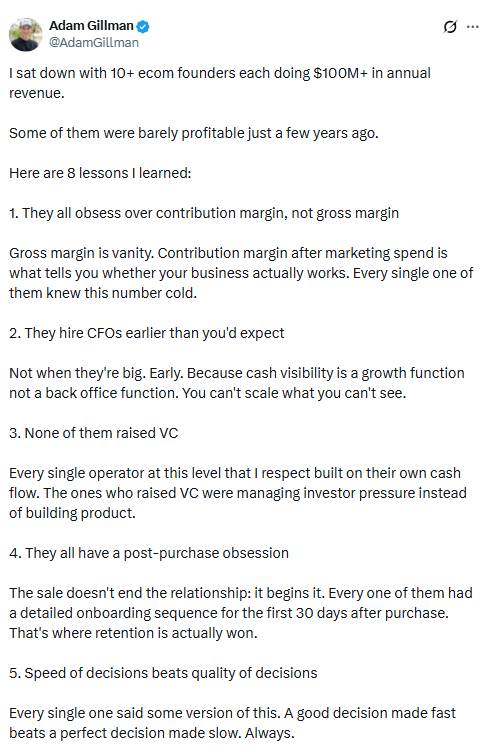
🐥 Tweet Worth Saving
Thanks for being part of the WAW team 💃 We’d love to know if this was helpful so we can continue playing it smart with the right strategies.