Your lookalike learned the wrong lesson
🚩It isn’t contaminated by awareness. it’s contaminated by what the seed list taught it to find, and more!

Hello! You've arrived at What Actually Works 🤓
We break down the real strategies, decisions, and plays that actually move the needle in your marketing, and here it for today.
🚩Your lookalike learned the wrong lesson
A prospecting campaign producing 31.8× ROAS on a $980 monthly budget looks exceptional at first glance. In reality, numbers like these often say more about the audience than the campaign itself.
At that spend level, the algorithm can satisfy delivery with the easiest conversions available. The real question isn’t whether the campaign performs. It’s whether the same performance survives once the budget forces the algorithm to search beyond those easy wins.
The usual explanation doesn’t quite fit
When a lookalike audience outperforms broad targeting, the common assumption is that it’s finding people who already know the brand.
That sounds reasonable.
The problem is that awareness isn’t selective.
If brand familiarity is genuinely widespread, it should exist across the broader market as well, not only among people who resemble existing customers. Awareness alone doesn’t explain why a lookalike repeatedly behaves like a warmer audience.
The seed list is teaching something else
A lookalike model isn’t trying to find people who recognize your brand.
It’s trying to find people who resemble the seed audience it was trained on.
If that seed list is dominated by customers who converted quickly with very little persuasion, the algorithm learns to prioritize the same behavioural pattern again.

The audience isn’t necessarily warm because it knows your brand.
It’s warm because the model has learned what an easy conversion looks like.
That’s a much more durable bias.
Test the audience, not the assumption
The cleanest way to separate those effects is to test multiple prospecting audiences under identical conditions.
Run a lookalike alongside a genuinely broad or interest-based audience using the same creative, offer and landing page. Compare customer acquisition cost directly rather than assuming one audience represents “true” prospecting.
Then repeat the test as spend increases.
Small budgets rarely reveal how acquisition cost changes once the easiest pockets of demand have been exhausted. Gradually scaling each audience across multiple budget levels exposes that curve far more reliably than judging performance from a single snapshot.
The impressive ROAS number isn’t the real insight.
The shape of the CAC curve, once each audience is forced beyond its easiest conversions, tells you far more about what the algorithm actually learned from your seed list.
Partnership with Insense
Save 40+ hours monthly on influencer sourcing
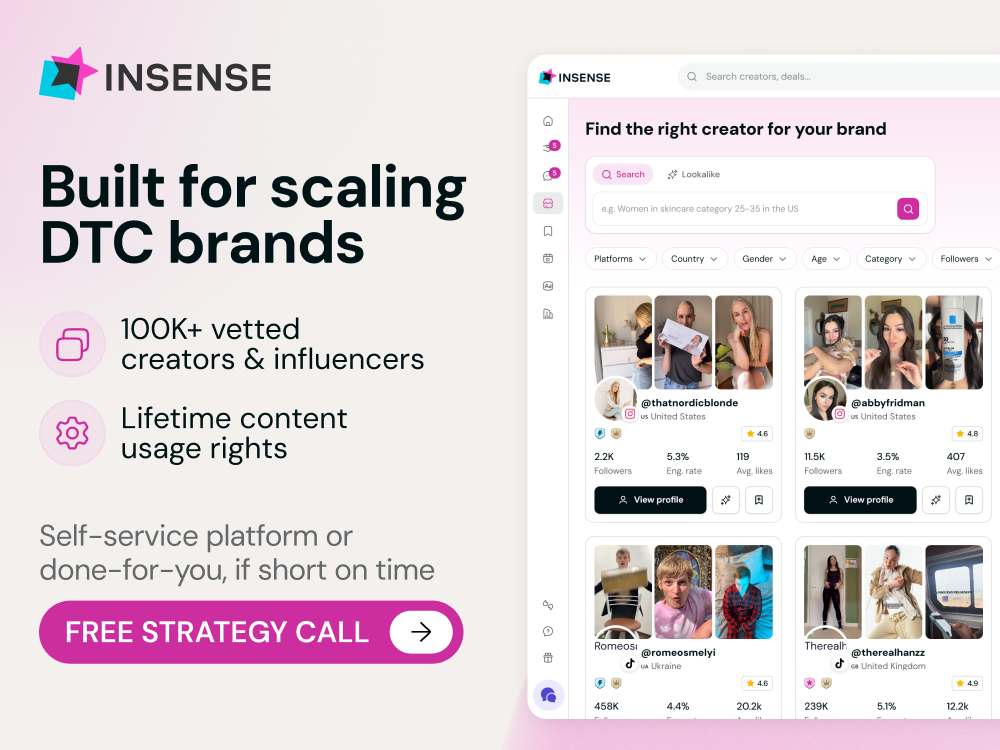
Manual influencer sourcing is the biggest time drain in creator marketing: scrolling profiles, cold DMing, chasing contracts, logging payments, all for a fraction of the creative volume your paid social demands.
Insense, built for DTC brands scaling past $2M, fixes the workflow:
- Launch a brief and get creator applications within 48 hours from a vetted 100K+ creator marketplace with creators across 57+ countries
- Receive UGC in 14 days with lifetime usage rights included
- Run and manage multiple campaign types: UGC, seeding, TikTok Shop, Meta Partnership Ads & Spark Ads from one dashboard
Insense is trusted by over 3,500 brands, including Beauty Pie, Wellhub, and PetLab Co.
Book a free strategy call by August 28 and get $200 platform credits towards your first campaign!
🐥 Tweet Worth Saving
Thanks for being part of the WAW team 💃 We’d love to know if this was helpful so we can continue playing it smart with the right strategies.