Why Incrementality fails for you
🥲Because what you planned for it on paper isn’t implemented, and more!

Hello! You've arrived at What Actually Works 🤓
We break down the real strategies, decisions, and plays that actually move the needle in your marketing, and here it for today.
🥲 Why Incrementality Programs Cut More Than They Ever Scale
Incrementality testing is supposed to answer a simple question: should this budget grow, move, or disappear? All three are legitimate outcomes, and all three can be backed by the same level of statistical rigor.
Yet they rarely move through an organization at the same speed. The difference has little to do with the quality of the evidence and everything to do with how organizations are wired to make decisions.
Every incrementality test has three possible outcomes

On paper, each conclusion deserves the same level of confidence. In reality, they don’t receive the same level of support.
Why cuts move faster than growth
A recommendation to cut spend is relatively easy to approve. It reduces risk, protects margins, and rarely requires anyone to argue for investing more money during an uncertain period.
A recommendation to increase spend asks the organization to do the opposite. Someone has to approve additional budget, believe the results will hold at higher spend levels, and ultimately defend that decision if the following quarter underperforms for completely unrelated reasons.
Both recommendations may come from the same experiment.
Only one feels safe.
The organization isn’t reacting to the data. It’s reacting to the decision.
This is a well-documented pattern in decision-making. Organizations tend to treat preventing losses as more urgent than pursuing equivalent gains.
Inside an incrementality program, that shows up in subtle ways:
- Non-incremental spend gets approved for removal almost immediately.
- Budget increases trigger additional reviews and planning cycles.
- Proven winners wait for funding long after the evidence is accepted.
The data hasn’t become less convincing. The approval process has become more cautious.
The long-term consequence
Over several quarters, the program starts behaving like a one-way valve.
Waste gets identified and removed with very little friction. Confirmed growth opportunities accumulate in presentations while waiting for the next planning cycle, the next budget review, or another round of validation.
Eventually, the program develops a reputation for improving efficiency without accelerating growth, even though it has already identified where that growth should come from.
Build a fast lane for scale, not just cuts
Most organizations already have an efficient approval path for reducing spend. They need one for increasing it too.
Before the next incrementality study begins, define:
- What level of evidence automatically qualifies for additional investment.
- How much budget can be released without a full review cycle.
- Who approves that investment.
- How quickly the budget should move once the evidence is confirmed.
Without that second approval path, an incrementality program will keep finding real winners while remaining structurally better at cutting spend than funding growth.
Partnership with Tatari
When Meta hits a ceiling, the smartest brands look beyond it.

Scaling digital used to be straightforward. Now brands hit a Meta Ceiling where reach stalls and CAC skyrockets.
The brands still compounding aren't fixing it inside Meta. They're diversifying.
Tatari is a TV buying platform that lets you run across linear TV, streaming, and direct publisher buys, all from one place.
You see exactly where every ad aired, so nothing is hidden, and nothing is wasted. Every dollar ties back to actual site visits, signups, and revenue not impressions that look good and prove nothing.
- Aroma360 cut CPA by 80% and doubled ROAS from a $14K linear pilot
- Fiverr retargeted Super Bowl viewers on streaming and slashed CAC by 75%
- Saatva saw a 40% lift in branded search from their very first Tatari test
Every week you wait is a week someone in your category is pulling customers you could have reached first.
Book a free demo and get a launch-ready TV plan built around your numbers.
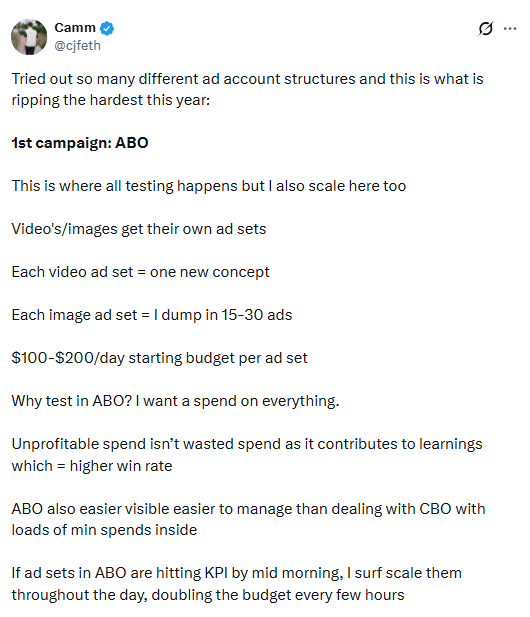
🐥 Tweet Worth Saving
Thanks for being part of the WAW team 💃 We’d love to know if this was helpful so we can continue playing it smart with the right strategies.