Pre-Planned Fallbacks Save the day
😵💫 Pre-plan fallbacks if not, you’ll waste time and money at the face of failure, and more!

Hello! You've arrived at What Actually Works 🤓
We break down the real strategies, decisions, and plays that actually move the needle in your marketing, and here it for today.
🙏 Pre-Planned Fallbacks Save the day
The $10M growth loop looks clean:
- UGC drives ads.
- Ads drive trials.
- Trials feed post-purchase.
- Reviews generate new UGC.
- On repeat.
The issue isn’t awareness. It’s fragility.
You build this loop assuming every stage will perform consistently. In reality, one part slows every quarter. Content pauses. CPMs rise. Conversion dips. Review velocity drops. When that happens, growth stalls because there’s no structural backup.
A real compounding system isn’t just connected. It’s insulated.
1. When UGC Slows
Content usually dries up for three reasons: creator fatigue, declining novelty, or inconsistent seeding.
Fallback architecture:
Extraction Layer: Systematically convert written reviews, post-purchase surveys, and support wins into ad scripts. Build a monthly “proof mining” session into operations.
Pipeline Layer: Maintain a rolling creator pipeline instead of campaign bursts. Tools like Modash help assess creator risk, vet partnerships, and reduce uncertainty before content goes live. You can try Modash free for 14 days.
Reserve Layer: Keep a 60–90 day creative bank. Ads should not depend on this week’s submissions.
If fresh content slows, proof should still flow.
2. When Paid Efficiency Drops
Performance drops rarely mean demand disappears. It usually means the structure didn’t adapt.
Fallback architecture:
Offer Modularity: Pre-build bundle variations and price anchors so swaps can happen without redesigning funnels.
Channel Buffer: Have email, SMS, and affiliate pushes ready to activate when CPAs spike to protect blended CAC.
Creative Rotation Protocol: Refresh hooks on schedule, not in panic mode. Fatigue should be expected, not reacted to.
Paid should accelerate growth, not carry it alone.
3. When Retention Weakens
If reorder velocity dips, the problem is usually habit formation.
Fallback architecture:
Consumption-Based Triggers: Automated reorder nudges based on real usage cycles, not arbitrary timelines.
Engagement Incentives: Reward reviews, referrals, or UGC creation with credits tied to next purchase.
Reactivation Tracks: Segmented winback flows by AOV and purchase frequency, pre-built before decline happens.
Retention needs redundancy.
4. When Reviews Slow
Proof is momentum fuel. When it slows, future acquisition weakens.
Fallback architecture:
Timed Review Windows, Short incentive bursts post-delivery.
Packaging Triggers
- QR-based instant review or video prompts.
- Community Recognition
- Publicly highlight reviewers to create social proof loops.
The brands that cross $10M don’t just build growth loops.
They build pressure-resistant systems.
Each stage has a primary driver, a backup driver, and a recovery trigger. That’s the difference between momentum and dependence.
Compounding doesn’t come from perfection. It comes from systems that survive imperfect months.
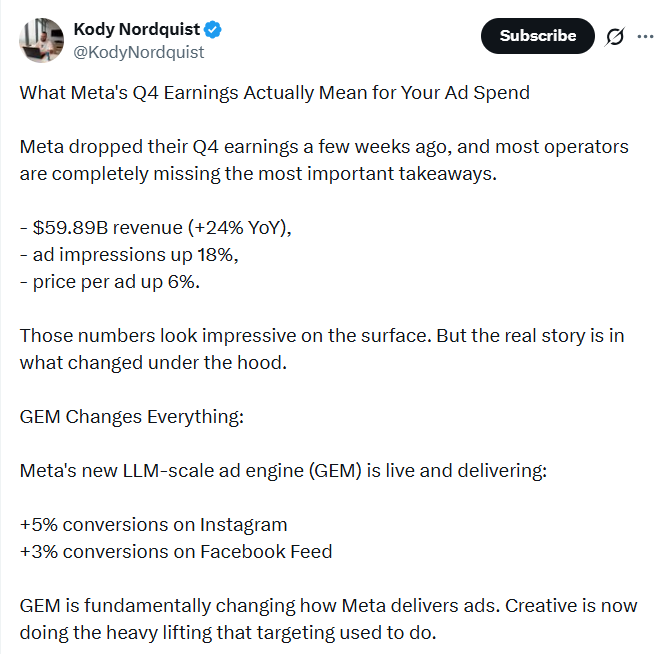
🐥 Tweet Worth Saving
Thanks for being part of the WAW team 💃 We’d love to know if this was helpful so we can continue playing it smart with the right strategies.