The Third Purchase Effect
😲The most important transaction in your business, and more!

Hello! You've arrived at What Actually Works 🤓
We break down the real strategies, decisions, and plays that actually move the needle in your marketing, and here it for today.
😲The Third Purchase: The Most Important Transaction in Your Business
Everyone has a first-purchase obsession. Every optimization dollar, every creative test, every landing page iteration exists to convert a stranger into a buyer. The third purchase gets nothing, because by the time it happens, most brands have already moved on to acquiring the next stranger. That’s the gap where retention programs silently fail.
Why the third purchase is structurally different
The first purchase is a bet. Buyer’s remorse is highest. Trust is lowest. The second purchase is validation; they liked it enough to return, but they’re still evaluating. The third purchase is commitment.
Psychologically, the customer shifts from “I buy from this company” to “I’m a person who uses this product.” Identity has locked in. Churn becomes structurally unlikely because switching now means admitting the identity was wrong.
Your retention program’s entire job is engineering the path from purchase 1 to purchase 3 as fast as possible. Everything else is noise.
What the cohort data actually shows
Most brands track repurchase rate as a single aggregate
number. The insight lives in the disaggregated view. Run these four questions across your customer base:
- Of customers who bought in January, what percentage repurchased in February, March, and April?
- What is the median time between purchase 1 and purchase 2 on your hero product?
- What percentage of customers who reach purchase 2 go on to purchase 3 within 90 days?
- Which product combination most reliably produces a third purchase?
Most brands that run this analysis discover the gap isn’t between purchases 2 and 3. It’s between purchases 1 and 2. They’re losing customers before the relationship has a chance to compound.
The strategies that engineers deliberately purchase 3
Map your hero product’s natural consumption timeline and build your post-purchase sequence around it. If your supplement lasts 30 days, your repurchase prompt arrives on day 25, not day 45 when the customer has already bought from a competitor.
Most post-purchase flows run on arbitrary timing. Consumption dictates the clock, not your ESP’s default sequence.
Identify your purchase 2 to purchase 3 bridge product. Run a cohort analysis on every customer who reached purchase 3 and work backwards.
What did they buy on purchase 2? In most DTC businesses, one specific product or bundle acts as the bridge. Find it, then build a targeted offer exclusively for customers who have completed purchase 2.
Use purchase 2 as the trigger for your highest-value retention investment. A handwritten note, an unexpected gift, a founder email, a loyalty program invitation. The cost is minimal. The impact on purchase 3 probability is disproportionate because it arrives exactly when the customer is most receptive to deepening the relationship.
Build a dedicated winback sequence for customers who stalled after purchase 2. These are not the same as one-time buyers. They were close to commitment, and something interrupted the path. A separate flow with a stronger offer recovers a meaningful percentage that a generic winback sequence completely misses.
The Bottom Line
CAC on Meta has gone from $5 in 2016 to $40-60 today, and it will not reverse. The only structural answer is a customer base where the third purchase finances the next stranger’s first.
Partnership with Insense
The agency has 11 other clients. You're not all of them.
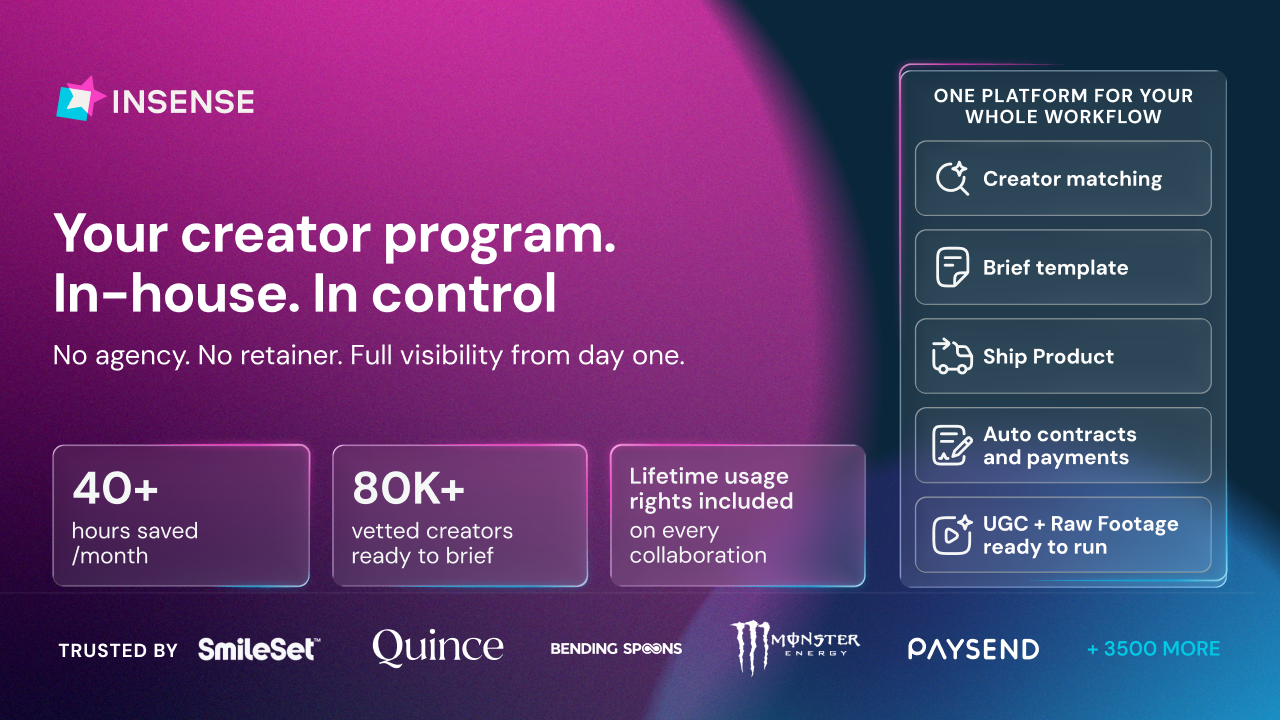
You hired the agency for expertise. What you got was a shared Slack channel, a monthly report, and content that takes six weeks to turn around. That's six weeks of dead test cycles while your competitors are already scaling winners.
Insense is the self-serve platform for brands ready to take this in-house. 80,000+ vetted creators waiting on your brief right now.
- First creator applications in 48 hours while the agency is still writing your brief
- Lifetime usage rights on every collaboration, locked in automatically
- Run UGC, TikTok Spark Ads, Meta whitelisting, and product seeding from one dashboard
Trusted by 3,500+ brands including Quince, Monster Energy, and Paysend. Teams save 40+ hours every month, starting campaign one.
Book a free strategy call before May 8 and get $200 in platform credit toward your first campaign.
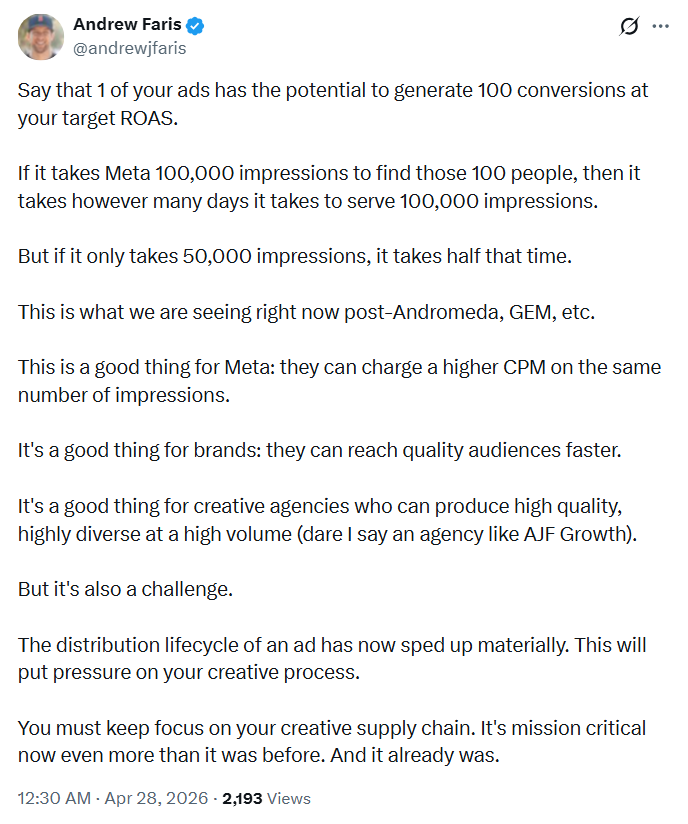
🐥 Tweet Worth Saving
Thanks for being part of the WAW team 💃 We’d love to know if this was helpful so we can continue playing it smart with the right strategies.