SEO is about two algos now
🥲You're writing for one algorithm. There are two now, and more!

Hello! You've arrived at What Actually Works 🤓
We break down the real strategies, decisions, and plays that actually move the needle in your marketing, and here it for today.
🥲You're writing for one algorithm. There are two now.
Content teams are optimizing for a game that's only half the board.
Rankings. Impressions. Organic traffic. The metrics haven't changed so the assumption is that the strategy shouldn't either. Write for search intent, hit the right keywords, build authority signals. Job done.
Except there's a second algorithm making content decisions now, and it doesn't work anything like the first one.
Why the same content can't serve both
Search algorithms rank pages against each other based on relevance, authority, and topical coverage built over time.
AI retrieval doesn't rank. It extracts. It looks for content that directly answers a question, clean entity signals, an unambiguous structure, and language that maps precisely to how the question was asked. Not the best page on a topic. The most directly retrievable answer to a specific query.
The content decision that wins a ranking often loses a citation. A long-form pillar page signals authority across a subject and ranks well. That same page gets skipped by AI retrieval because the specific answer is buried inside 3,000 words of context.
Two algorithms. Two definitions of useful content. One strategy trying to serve both and doing neither fully.
What changes when you write for retrieval
Specificity over coverage. Search rewards comprehensive pages. AI rewards specific answers. A page answering one precise question with direct language retrieves better than a page covering everything about the same topic.
Entity clarity over keyword density. AI builds answers around named entities, brands, concepts, processes, not keyword frequency. Content that clearly names and defines its entities gets retrieved. Content optimized purely for keyword placement gets ranked but skipped.
Direct answerability over narrative flow. Long editorial introductions work for human readers. AI crawlers extract the answer and leave. If the directly answerable content isn't near the top and clearly structured, retrieval fails regardless of overall quality.
Grounding terms over search keywords. The language AI uses to pull content differs from what humans type into Google. Semrush One's Prompt Research tool surfaces the exact grounding terms AI uses when generating answers in your category, distinct from traditional keyword data. You can try it for free for 7 days.
How to audit for retrieval gaps
Take your five highest-traffic pages and ask:
- Is the core answer extractable in the first 150 words?
- Are key entities named and defined clearly?
- Does the language map to how AI generates answers in your category?
If any answer is no, the page ranks. AI skips it. Every AI-generated answer in your category that doesn't cite you is sending traffic somewhere else.
Two algorithms are deciding your content's visibility. Optimizing for one is only half a strategy.
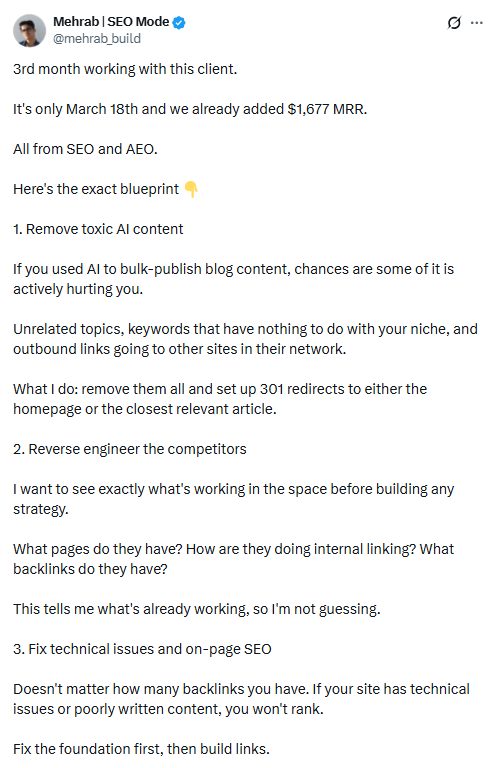
🐥 Tweet Worth Saving
Thanks for being part of the WAW team 💃 We’d love to know if this was helpful so we can continue playing it smart with the right strategies.